NRC-licensed reactor operator · UMass Lowell Research Reactor

Computational Health Physicist.
Reactor & Radiation Modeling Specialist.

I'm Dan Gill, a reactor operator at the 1 MW UMass Lowell Research Reactor and an M.S. candidate in Radiological Sciences and Protection. I build the Monte Carlo models, instrumentation software, and dosimetry systems. Check out my research and resume below!

MCNP6.3/OpenMC/Python/Slurm + OpenMPI/C++/Nuclear Modeling

Portrait of Daniel Gill

About

Measurement and simulation, same job

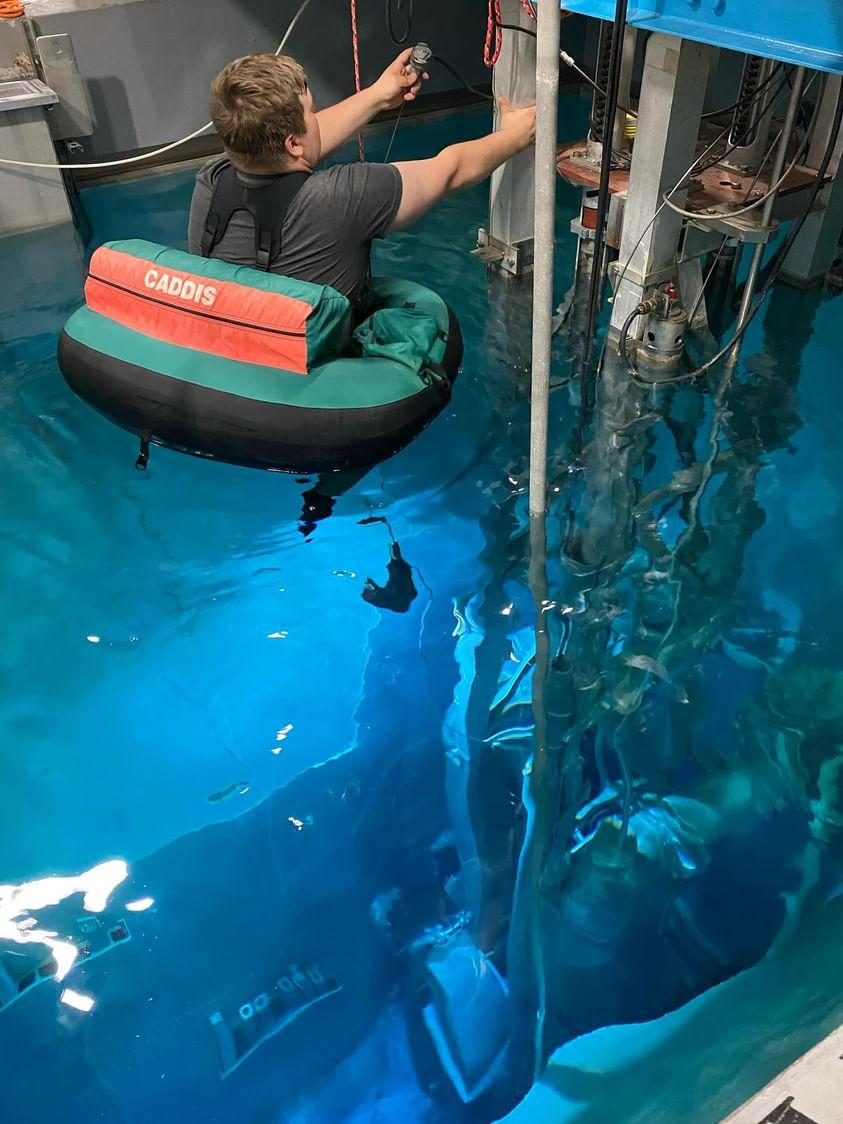
I finished my B.S. in Physics at UMass Lowell in May 2026 and stayed for the M.S. in Radiological Sciences and Protection, expected May 2027. Since April 2024 I've worked in the UMLRR control room, first as an auxiliary operator and now as an NRC-licensed reactor operator, running the reactor for experiments and client irradiations.

Based in
Windham, New Hampshire
License
NRC Reactor Operator, UMass Lowell Research Reactor
Certification
Nuclear Criticality Safety, Levels I & II
Education
M.S. Radiological Sciences & Protection (exp. 2027), B.S. Physics (2026)
Affiliations
American Nuclear Society, past president of the UML Society of Physics Students

Research

Two problems I keep coming back to

M.S. thesis · in progress

Transistor neutron dosimetry

The UMLRR measures fast-neutron fluence with 2N2222A transistors: irradiate, anneal, measure the gain drop, apply the Messenger-Spratt equation per ASTM E1855. I built the full chain, from Keithley source-measure instrumentation over GPIB to a fluence calculator with complete uncertainty propagation, and characterized devices from 1×10¹⁰ to 6×10¹⁴ n/cm².

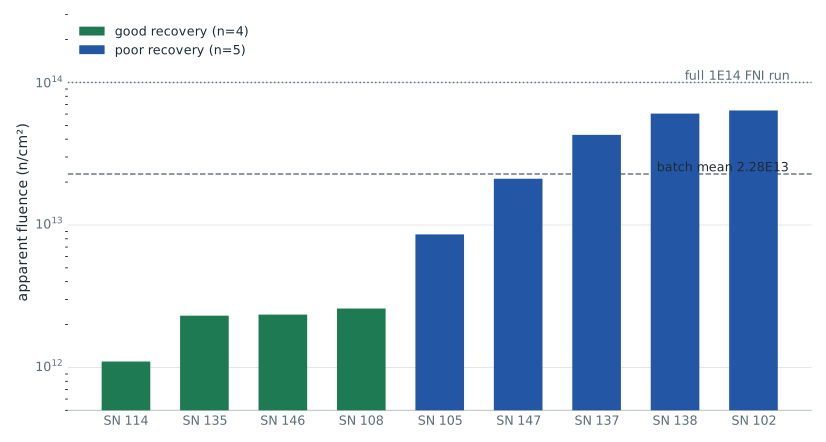
Then the system found something. Nine matched-history devices given an identical 12,400 rad Co-60 dose split into two clean populations after the standard anneal, separated by a factor of 19 in residual damage. Figuring out why, and what it means for low-fluence dosimetry, is now the heart of the thesis.

Bar chart of apparent neutron-equivalent fluence for nine transistors after a pure gamma exposure, split into a good-recovery cluster and a poor-recovery cluster

B.S. capstone · spring 2026

Shielding verification for the UMLRR 5 MW upgrade

UMass Lowell plans to take the reactor from 1 MW to 5 MW. My capstone built a Python tool that turns MCNP fluence spectra into combined neutron and photon dose profiles through concrete, using Berger buildup factors, Wyckoff-Chilton dose conversion factors, and Brent's method to solve for the required shield thickness.

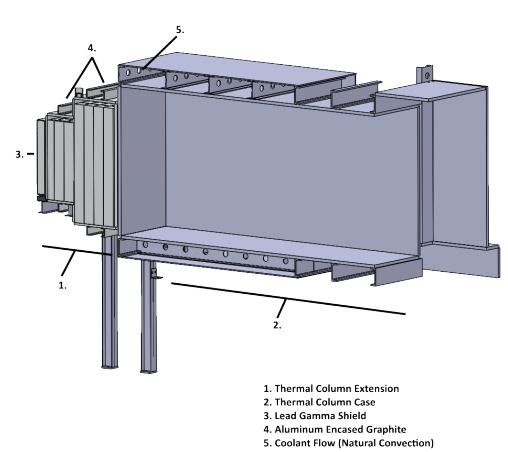
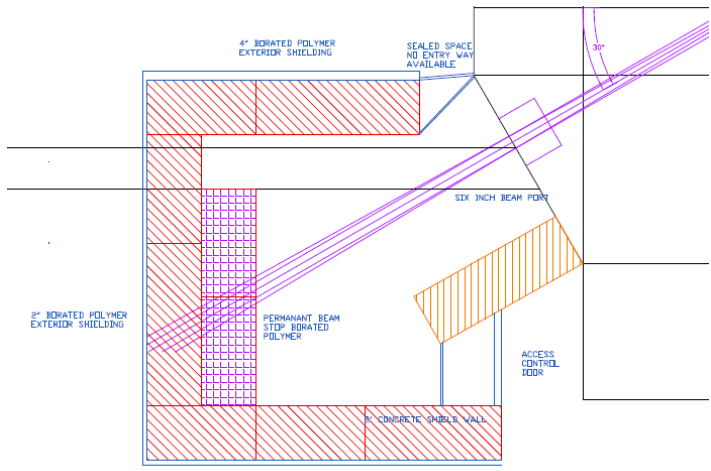
At 5 MW the beam port needs 196 cm of ordinary-concrete-equivalent shielding and the thermal column 195 cm to hold the boundary at 2 mrem/h. Along the way I found four typographical errors in a standard reference's dose conversion table by checking it against the 1973 original.

Isometric CAD view of the UMLRR thermal column assembly showing the extension, case, lead gamma shield, and aluminum-encased graphite

Projects

Github Projects and Tools

MCNP23DAN

Converts MCNP input decks into watertight 3D meshes (GLB, STL, OBJ, PLY) so anyone can view a reactor model without MCNP, CAD software, or a license. A purpose-built CSG parser handles surfaces, macrobodies, transforms, universes, and lattices, and a bundled offline three.js viewer opens results in one click. Volume validation on the Godiva sphere converges to within 0.01% of the analytic value.

python · marching cubes · three.js · pyinstaller

View on GitHub →

Kerma

A programming language for physics and math, built from the lexer up. Python-like syntax compiles to a custom 39-opcode bytecode VM, every value can carry units through arithmetic (371 units stored as dimension vectors), matrices and symbolic expressions are first class, and output renders Mathcad style in a browser notebook. 570 passing tests and no dependencies beyond numpy.

language design · bytecode vm · unit-aware types

View on GitHub →

Fast neutron filter

An MCNP6.3 design study for a graphite thermal column with an upstream bismuth gamma filter at the UMLRR 6-inch beam port, targeting a thermal-to-fast ratio of at least 100:1. A Python pipeline generates parameterized input decks, batches runs across a 3-node Slurm/OpenMPI cluster, parses MCTAL tallies, and folds the resulting spectra against the ASTM E722 silicon damage function.

mcnp6.3 · slurm · astm e722 · sdef synthesis

Feeds the thesis work →

Everything else

Eighteen public repositories and counting, including a radiation dose FastAPI service, an AlphaZero-style Carcassonne bot, and a webcam-driven mouse controller. Plus the 3-node Dell Precision Slurm cluster in my basement that runs the MCNP jobs.

github.com/drgtheneutrino

Browse the profile →

Contact

Get in touch

dan@dangillphysics.com